How prepared are medical students to recognise and care for people with rare diseases?
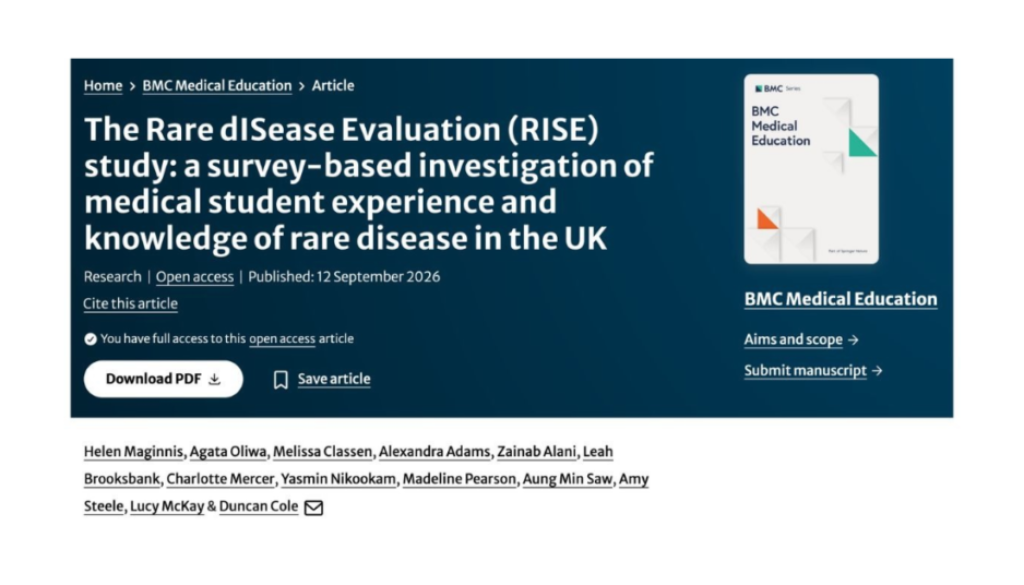
Dr Helen Maginnis, Training Programme Manager at Medics for Rare Disease, reflects on the findings of the Rare dISease Evaluation (RISE) study, published in BMC Medical Education.
There are 3.5 million people living with rare disease in the UK, and people living with very different rare conditions often report similar challenges. Many struggle to access a timely diagnosis, and even when they receive one, the follow-on care they need can be difficult to find and disjointed.
Medical school provides the foundations for a career in medicine. Students learn to recognise symptoms, investigate possible diagnoses and make decisions about patient care. However, until recently there was limited information available about how well UK medical schools are preparing future doctors to recognise and care for people living with rare disease.
In conjunction with the University of Cardiff, Medics for Rare Disease set out to find out more, and I was delighted to see our findings published in BMC Medical Education in September 2026.
How and why did we undertake this research?
We wanted to understand what UK medical students know about rare disease, what teaching they had received on the subject, and whether they felt prepared to recognise or consider a rare disease in clinical practice. Crucially, we also wanted to hear directly from students about the education they felt they needed.
To gather insights, we developed an online questionnaire exploring these topics, which was shared with UK medical schools. We received 126 fully completed responses from students at 27 medical schools. We analysed these to identify patterns in knowledge, educational experiences and students’ views on further training. Written responses also helped us understand some of the challenges students face when learning about rare disease.
What did we find?
One of the most striking findings was how unprepared students felt for clinical practice.
Only one in five respondents felt prepared to recognise or consider a rare disease in practice, despite more than half having received some rare disease education during medical school.
There was, however, encouraging evidence of students’ appetite for learning: almost three-quarters wanted further rare disease education.
The message was clear: students recognise that rare disease matters, but many do not feel their existing education adequately prepares them for the realities of clinical practice. Some students also shared concerns about curriculum overload, explaining that they felt they had to prioritise other topics over learning about rare disease.
“It is not that medical students aren’t interested in rare disease, it is rather that they are forced to prioritise their learning in order to progress.” – free text comment from survey respondent
Learning from lived experience
Our findings also highlighted the potential value of connecting medical students with people living with rare disease.
Students who had greater clinical exposure to people living with rare disease, or a personal connection to the rare disease community, reported higher levels of knowledge and awareness.
However, these experiences were not associated with higher rare disease knowledge scores when students were tested. This distinction matters: meaningful contact can help students appreciate the realities of living with a rare condition, but experience alone may not provide all the knowledge and practical skills needed to recognise and care for people living with rare disease.
Our findings therefore support an approach that brings together lived experience and structured education, helping students connect what they learn in the classroom with the experiences of the people they will care for.
Why does this evidence matter?
At Medics for Rare Disease, we believe that improving the experiences of people living with rare disease begins in our medical schools. This means challenging the assumption that rare disease is a niche or specialist subject, and helping students understand the core components of good care that apply across the rare disease spectrum.
It would be impossible for any student to learn the details of every one of the 6,000+ rare conditions. But our approach to educating students about cancer, which encompasses many different conditions with shared patient experiences and needs, demonstrates why this level of detail is not necessary for students to enter practice better informed and more able to recognise and support affected people.
Instead, we need to consider how medical education can equip future doctors with transferable knowledge and skills: recognising when a rare disease might be a possibility, managing diagnostic uncertainty, listening to patients and knowing when and where to seek specialist advice.
The RISE study provides evidence to support the case for more consistent, structured and practical rare disease education across UK medical schools. It also gives us a stronger foundation for conversations with medical educators and those responsible for shaping undergraduate curricula.
As a charity, we want every future doctor to understand the challenges faced by people living with rare disease and feel better equipped to provide compassionate, informed care.
What comes next?
Publishing this research is an important milestone, but it is only one step towards change. At MfRD, we will continue working to improve rare disease education and support medical students and educators with accessible, relevant learning opportunities. We also hope to see universities take the critical step of formally integrating rare disease content into their curricula.
I am incredibly grateful to everyone who contributed to the RISE study, particularly the medical students who took the time to share their experiences, our principal investigator, Professor Duncan Cole, my joint first author, Agata Oliwa, and all our co-authors.
Ultimately, we hope these findings help ensure that rare disease education becomes a more consistent and meaningful part of medical training, so that future doctors are better prepared to recognise when something might be rare, listen to the people affected and help them access the care they need.
You can read the the full RISE study in BMC Medical Education: https://doi.org/10.1186/s12909-026-10338-z