
Rare Disease Quality Standards QS214
Rare Disease Quality Standards QS214
This year, NICE published the first ever Rare Disease Quality Standard (QS214). This was a huge milestone for the rare community. It was published at the end of February but with all of the noise surrounding Rare Disease Day it was easily overlooked. I wanted to give a quick summary of what it is and why it matters. Medics for Rare Disease helped in the development of this Quality Standard. You may want to revisit our podcast episode in which we discuss the proposed statements.
What is a Quality Standard?
A ‘Quality Standard’ is a document published by the National Institute of Clinical Effectiveness (NICE). It is essentially a set of statements that outline what quality care ‘should’ look like, for a particular condition or group of people. These ‘Quality Statements’ are measurable and provide a framework to assess and improve care quality. Quality Standards are of value to NHS services, commissioners, regulators and importantly, service users, to assess care. Because quality standards include measurable elements it allows gaps to be identified and improvements to be tracked over time.
Quality standards also guide how services are designed and funded. Commissioners and system leaders can use quality standards to shape services and allocate resources. This can help make care more coordinated and planned.
Whilst Guidelines are detailed and comprehensive (designed to support clinical decision-making), Quality Standards are shorter and more focused. They list the most important actions that should happen, regardless of where care is delivered.
Having a Rare Disease Quality Standard is important because it establishes ‘Rare Disease’ as a distinct and important area of medicine. A measurable framework to gauge the quality of care is a positive step forward.
Relevance to People Living With Rare Conditions
For people living with rare conditions – often facing delays in diagnosis, fragmented care and unequal access to treatment depending on location – a Quality Standard provides a clear and shared benchmark for good care. These agreed priorities, or ‘standards’, should help to ensure that patients in differing locations receive a similar standard of care. This is especially important in rare diseases, where expertise may be concentrated in certain centres and pathways are not always well established.
Just as importantly, this Quality Standard can be used to empower those impacted by rare conditions. They provide a clear, authoritative reference point for what care should look like. This means individuals, families, and advocacy groups are better equipped to ask informed questions, highlight gaps, and advocate for change.
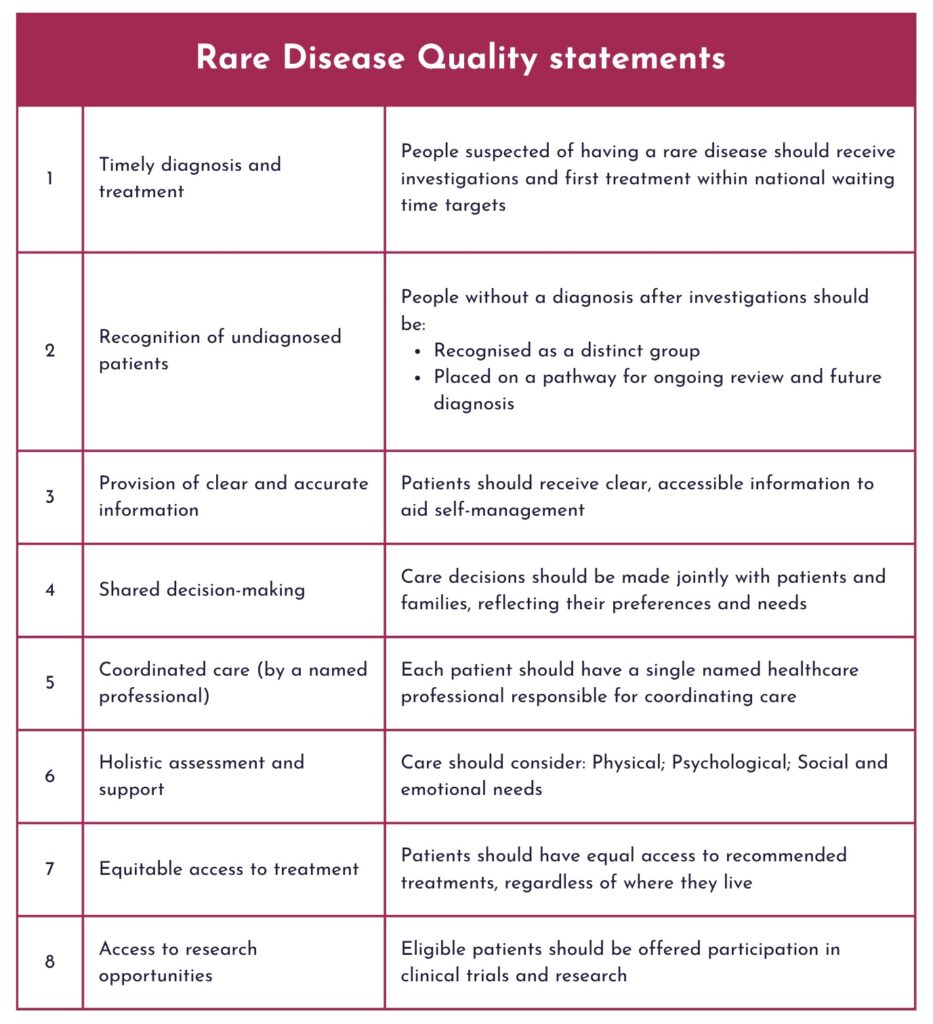
Eight Quality Statements for Rare Aware care
The eight statements define high quality care across the entire rare disease pathway, from suspicion and diagnosis, through to long-term management and treatment. It applies to people with rare disease of all ages and also includes those who are diagnosed and also those with suspected rare diseases who remain undiagnosed.
Deep Dive into the Rare Disease Quality Standard
This is the first ever Quality Standard specifically for Rare Disease. It is novel in that it covers the whole pathway, including undiagnosed patients and not just those with a rare disease diagnosis. This is important as it includes those people who are still struggling within a diagnostic odyssey. It acknowledges these people and gives them a measure to assess their own care, whilst allowing this part of the diagnostic odyssey to be improved upon. There is a focus on equity with waiting times and treatment access being prioritised.
Equity
The focus on equity is to be commended. Statement 1 focuses on diagnosis, within national waiting time targets. This is an impressive goal to reach for and aligns with our own charity mission at Medics for Rare Disease. With the average time to diagnosis being five years for those people with rare disease, having a priority for a timely diagnosis is an excellent first statement to measure equity and work to improve it. Statement 7 is also focused on equity – prioritising equal access to recommended treatments. This is a measurable and essential part of providing an equitable quality of care.
Shared-decision making
Statement 3 highlights shared decision making and the desire of people with rare disease to feel included within their care decisions. Whilst this may seem like a given, people with rare conditions commonly report feelings of powerlessness within their healthcare journey. Shared decision making should be part of all good clinical medicine and it is definitely something that should be monitored to ensure quality of care.
Co-ordination of care
Statement 5 is about having a named professional care leader for coordination of care. Often overlooked in general medicine, coordination of care can be a huge burden to families impacted by rare conditions. With multidisciplinary care common, people with rare disease often have to attend multiple consultations and tests at different hospitals. For people dealing with the stress of ongoing symptoms and uncertainty, coordinating care is a full time job and additional mental load for whole families. A named healthcare professional can be a huge relief to families and ensure that care is provided keeping schedules and family needs in mind.
A Collective and Unique Profile of Needs
Statement 6 and 8 feel very specific for rare disease. People with rare conditions have a very distinct set of challenges; from the mental load of living with uncertainty to the tumultuous diagnostic process and feelings of isolation due to the rarity of a condition. There is a considerable strain on mental health. Holistic care for people impacted with rare disease is essential and can make a huge difference to their journey. Also distinct to rare disease is the hope that can be derived from the opportunities to take part in clinical trials. This is a point we emphasise in our Rare Disease 101 teaching and we are pleased to see it listed as a priority in this Quality Standard.
Final Thoughts
When we talk about improving healthcare, it’s easy to get lost in policies and clinical guidance. However the goal is simply to ensure that people receive the right care, at the right time, in the right way.
The new QS is a welcome document from NICE. Much of it aligns with the UK Rare Diseases Framework and national action plans, along with Medics for Rare Disease’s charity mission and goals for equity of care. It is a great step forward in standardising rare care and providing a measurable framework to provide ongoing assessment of care quality and therefore where improvements need to be made.